BloodSweatxED
PRN Education · No. 001 · Fluids & Electrolytes

IV fluids are
medications.

Each bag has an indication, a dose, an adverse-effect profile, and a monitoring requirement. How confident are you in your IV fluid game?

Six common IV fluids, what they do, and where clinicians get into trouble. Built for the PAs, residents, and anyone who orders a bag. Use PRN.

The one-glance version

Print it. Tape it to the Pyxis.
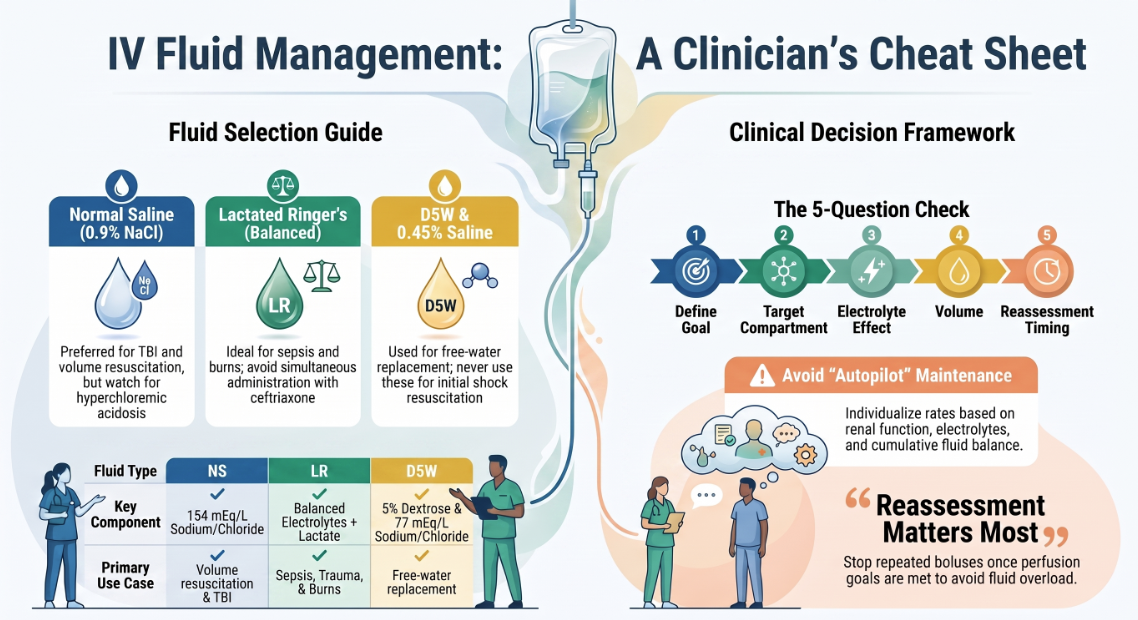
IV Fluid Management: A Clinician's Cheat Sheet. Fluid selection guide comparing Normal Saline, Lactated Ringer's, and D5W with key components and primary use cases, plus a clinical decision framework: the 5-question check (define goal, target compartment, electrolyte effect, volume, reassessment timing), a warning to avoid autopilot maintenance, and the reminder that reassessment matters most.
Fig. 1 — The cheat sheet. The rest of this page is the fine print that keeps it honest.

The formulary

6 bags · indications · cautions

Read each one like a drug monograph, because that's what it is: what's in the bag, when to reach for it, and where it bites.

01

Normal Saline

0.9% sodium chloride · "NS" Resuscitation TBI-friendly

In the bag

  • Sodium154 mEq/L
  • Chloride154 mEq/L

That chloride is ~50% above plasma. It adds up fast.

Reach for it

  • Initial volume resuscitation
  • Hypovolemia
  • Chloride-responsive metabolic alkalosis
  • Hyponatremia with true extracellular volume depletion
  • Compatible carrier for most blood transfusions
  • Selected neurologic patients, including traumatic brain injury

Where it bites

Large volumes cause hyperchloremia and a non-anion-gap metabolic acidosis. That can muddy your acid-base interpretation and may affect renal perfusion.

Not automatic: NS is not automatically the correct maintenance fluid just because it's the default in the order set.
02

Lactated Ringer's

balanced crystalloid · "LR" Resuscitation Balanced

In the bag

  • Sodium~130 mEq/L
  • Chloride~109 mEq/L
  • Potassium~4 mEq/L
  • Calcium~3 mEq/L
  • Lactate~28 mEq/L

Lactate is metabolized primarily to bicarbonate — it's a buffer, not an acid load.

Reach for it

  • Sepsis and septic shock
  • Trauma without significant TBI
  • Burns
  • Perioperative fluid therapy
  • GI fluid losses
  • Diabetic ketoacidosis

Where it bites

The potassium myth: ~4 mEq/L of K. Mild hyperkalemia or stable CKD is not an automatic contraindication. Use greater caution in severe hyperkalemia, severe renal impairment, or marked potassium-retaining states.

Ceftriaxone: do not run LR and ceftriaxone simultaneously through the same line. Older than 28 days, sequential is fine with a thorough flush. Calcium-containing fluids are contraindicated in neonates on ceftriaxone.

Don't run LR through the same administration set as citrate-preserved blood unless your blood-bank protocol permits it.

03

Dextrose 5% in Water

"D5W" Free water Not for shock

In the bag

  • Dextrose50 g/L
  • Electrolytesnone

Isotonic in the bag. Once the glucose is metabolized, you gave free water.

Reach for it

  • Free-water replacement
  • Selected cases of hypernatremia
  • Preventing or treating hypoglycemia when glucose delivery is needed
  • Providing dextrose while continuing insulin in DKA or HHS

Where it bites

Not a resuscitation fluid. It provides little sustained intravascular volume expansion.

In hypovolemic hypernatremia, restore circulation with an isotonic crystalloid before replacing the free-water deficit.

Avoid routine free-water solutions in cerebral edema, elevated ICP, or acute brain injury.

04

Dextrose 5% in Normal Saline

"D5NS" · "DNS" Maintenance

In the bag

  • Dextrose50 g/L
  • Sodium154 mEq/L
  • Chloride154 mEq/L

Hyperosmolar in the bag. After the glucose is metabolized, the electrolyte effect resembles normal saline.

Reach for it

  • Selected maintenance regimens
  • Patients who need both sodium-containing fluid and dextrose
  • Continued insulin therapy when dextrose is required

Where it bites

NPO ≠ D5NS. Being NPO does not automatically mean a patient needs it.

Monitor for hyperglycemia, hyperchloremic acidosis, sodium and fluid overload, pulmonary edema, and worsening heart or kidney failure.

Maintenance fluid should be individualized to intake, losses, renal function, electrolytes, and glucose requirements.

05

Half Normal Saline

0.45% sodium chloride · "½NS" Hypotonic Not for shock

In the bag

  • Sodium77 mEq/L
  • Chloride77 mEq/L

Supplies both sodium and free water — half of each, roughly speaking.

Reach for it

  • Selected hypernatremia treatment, after circulation is restored
  • Replacement of specific hypotonic losses
  • Selected DKA or HHS protocols, based on sodium and osmolality trends

Where it bites

Not appropriate for initial shock resuscitation. Avoid routine use in cerebral edema, elevated ICP, acute brain injury, and major burns or trauma requiring intravascular expansion.

DKA/HHS: do not switch to ½NS automatically. Follow measured sodium, corrected sodium, effective osmolality, urine output, and the applicable protocol.
06

Hypertonic Saline

3% sodium chloride · "HTS" High-alert Hyperosmolar therapy

In the bag

  • Sodium513 mEq/L
  • Chloride513 mEq/L

Raises extracellular tonicity and pulls water out of cells. That's the whole point — and the whole risk.

Reach for it

  • Severe symptomatic hyponatremia
  • Hyponatremic seizures
  • Selected cerebral edema or intracranial hypertension

Where it bites

Don't wait on a central line. Severe symptomatic hyponatremia needs prompt, controlled treatment. 3% can run through a reliable peripheral IV with close site monitoring and institutional safeguards.

The initial goal is a small, controlled rise in serum sodium sufficient to improve dangerous neurologic symptoms — not immediate normalization.

Overcorrection → osmotic demyelination. Monitor sodium frequently. Be more conservative in chronic severe hyponatremia, alcoholism, malnutrition, liver disease, hypokalemia, or a very low initial sodium.

Balanced vs. Normal Saline

The eternal turf war

Why balanced usually wins

Balanced crystalloids like LR and Plasma-Lyte are often preferred for:

  • Sepsis
  • General critical illness
  • Surgery
  • Large-volume resuscitation

They produce less hyperchloremic acidosis. The outcome advantage is probably modest — and it is not universal.

When NS still earns its keep

  • Traumatic brain injury is present
  • A chloride load is specifically desired
  • Blood-product or medication compatibility requires it
  • A balanced solution is contraindicated or unavailable
Bottom line: the fluid you choose matters less than choosing it on purpose. Pick the bag for the patient in front of you, not the one the order set defaults to.

Eight ways to get burned

Seen at every bedside

Fluids without a goal

Is this resuscitation, maintenance, replacement, free water, or hyperosmolar therapy? If you can't name it, don't order it.

Boluses without reassessment

Between boluses: perfusion, blood pressure, cap refill, lungs, urine output, mental status, ultrasound, and the response to a passive leg raise or the last bolus.

Treating all hypotension as fluid-responsive

Persistent hypotension may need vasopressors, hemorrhage control, source control, inotropes, or treatment of obstructive shock — not another liter.

Hypotonic fluid for resuscitation

D5W and 0.45% saline do not provide reliable intravascular expansion. They are the wrong tool for the job.

Maintenance on autopilot

Many hospitalized patients need less than a traditional maintenance rate. Some need no IV maintenance fluid at all.

Ignoring cumulative balance

Medication carriers, nutrition, blood products, flushes, and enteral intake all count. The ins column doesn't lie — if someone adds it up.

"Daily labs" during active treatment

Severe dysnatremia, DKA, HHS, evolving kidney injury, and hypertonic saline all demand more frequent monitoring than the morning draw.

Routine hypotonic maintenance in kids

Most hospitalized children older than 28 days who need maintenance IV fluid should get an isotonic solution with appropriate dextrose and potassium. Important exclusions apply.

Before you sign the order

Five questions,
every bag.

A better way to prescribe fluids. If you can answer all five, the order is probably right. If you can't, stop and figure out which one you're missing.

  1. What is the therapeutic goal?
  2. Which compartment needs fluid?
  3. What electrolyte or acid-base effect will this solution have?
  4. How much should be given?
  5. When will the patient be reassessed?
ThirdFluid choice matters.
SecondFluid volume matters more.
FirstReassessment matters most.